
guide 01
What Godel Terminal shows you that your broker app doesn't
A stock I own made news last month. I did what you'd do — opened the broker app. It gave me a red number, a chart, and a three-paragraph story written four hours after the fact, summarizing a filing it didn't link. That's a broker app. It exists to take your orders. It shows you enough to keep you ordering.
Same moment, my screen, one browser tab:
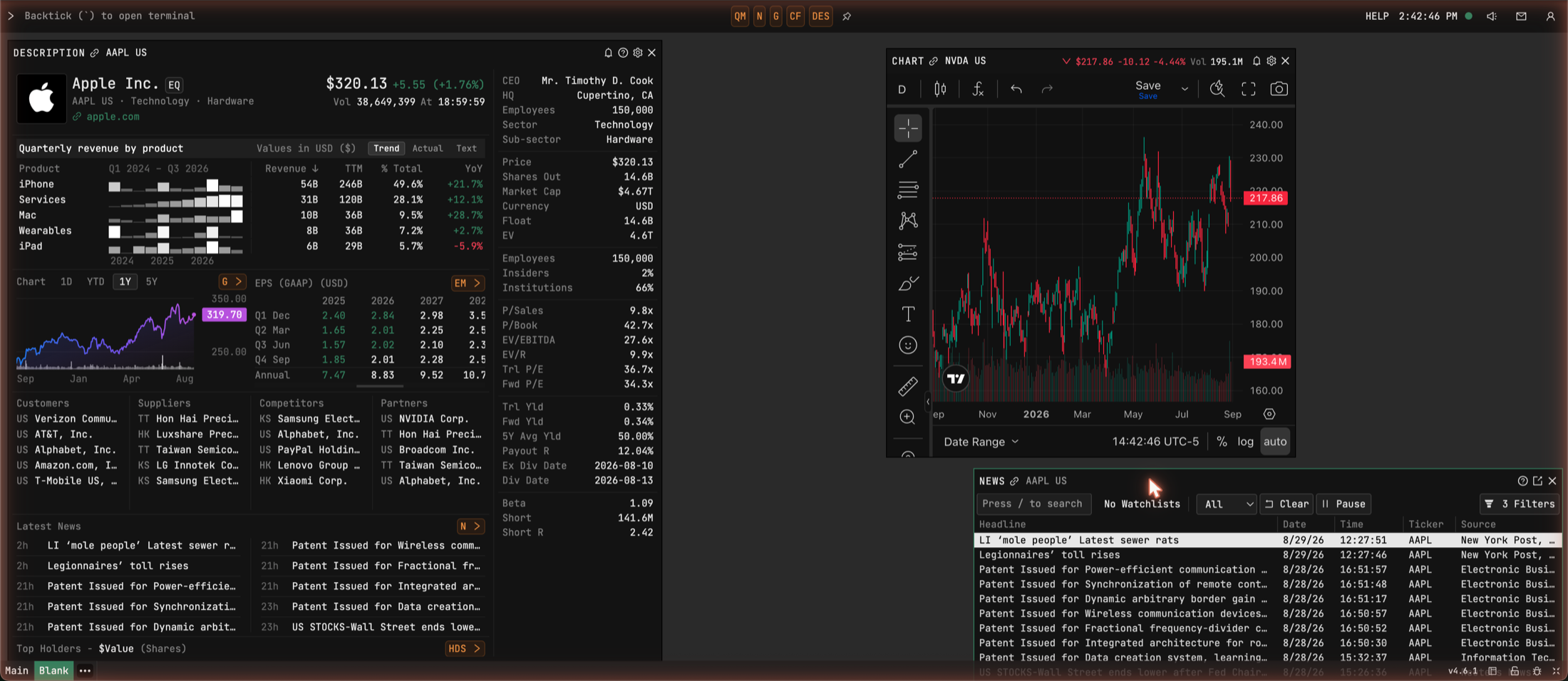
The screen is Godel Terminal. Facts up front so you can calibrate: Bloomberg-style terminal, runs in a browser, free tier exists, full seat is $118 a month, and the links on this site pay us a commission. I write these guides because I use the thing daily and most of what's written about it is either a press release or a discount-code farm. This page has one job — helping you figure out whether any of this matters to you. You, with a brokerage account and maybe an index fund. Not a desk.
The short answer
Your app shows prices, headlines, and last year's financials. Fine. What it doesn't show: filings the minute they're filed, who owns your stock and what they did last quarter, anything much beyond a few thousand US names, and what the options market is pricing in. None of that is secret. It's public information scattered across six sites you don't check. A terminal puts it on one screen and keeps it current. That's the product. The rest of this page is examples.
The gap between the event and the story
Information exists before your feed writes it up. Minutes sometimes, hours sometimes. Filings hit this terminal when they hit the SEC's servers, raw. The wire carries Reuters, Dow Jones, AP, dozens more, and breaking news paints a red banner across the screen no matter what you're doing — one fired on a Saturday, market closed, while I was building these guides. You don't need to be fast. You need to not be last.
Who owns your stock, and who just left
Pull up anything you hold. There's a table of every institution in the name — position size, and the column that matters: change since last quarter. Who added, who ran. A stock two funds hold at conviction size is a different animal from a stock a thousand index funds hold at market weight because a formula told them to. Ten seconds to check. Your app doesn't have the table.
The market past the famous part
The screener covers about 60,000 listings worldwide. First time I sorted it by market cap, Anthropic, OpenAI and SpaceX were sitting in the results with little P badges. Private companies, same table as everything else. Before you get excited: you can't buy them there, and the private rows are reference data, not an edge. The point is coverage. Free screeners know a few thousand US names. This one knows everything with a ticker, on any exchange, plus the stuff that doesn't trade yet.
Do you need it
Depends how you operate. If you check your account twice a week, this is a when-something-happens tool. A name hits your feed, a holding drops 8%, earnings next week — the question is whether twenty minutes of tab-hopping becomes three minutes on one screen. There's a guide for exactly that loop, and it's the right test. Run it tonight, on a stock you know, on the free tier. Costs you nothing but the half hour.
If it doesn't change how researching a stock feels, keep your app. It's fine at what it's for. If it does, the rest of the guides are the map.