
guide 04
Stop finding out late: a watchlist wall that watches while you don't
Tickers on this page are teaching examples, not recommendations. TickerFluent publishes education, not investment advice.
The worst feeling in this game isn't being wrong. It's finding out late — the name you'd been meaning to watch, down 9% by the time your feed mentions it, the move over, the decision made for you. I kept a watchlist in a broker app for years. It never saved me from that once. It refreshed when it felt like it, showed a price and a percent, and said nothing about when those numbers were from. Not a radar. A decoration.
This guide builds the real thing in Godel Terminal's Quote Monitor. Live lists
that flash as trades print, with a latency column showing how fresh every number
is. A chart and news window that follow your clicks. Alerts for the hours you're
not looking. It's the screen I leave up all day, and it's the other half of
the 3-minute triage loop — that
guide decides story or fire, this one makes sure names cross your screen before
they cross your feed. (Practice names here are AAPL, NVDA, SPY — liquid on
purpose, recommendations never.)
The empty room
Backtick, QM, Enter. You get an empty window that says "Create a Watchlist to get
started" — and the important furniture is in the corners: a … button top-left
and a gear top-right. Click the …:
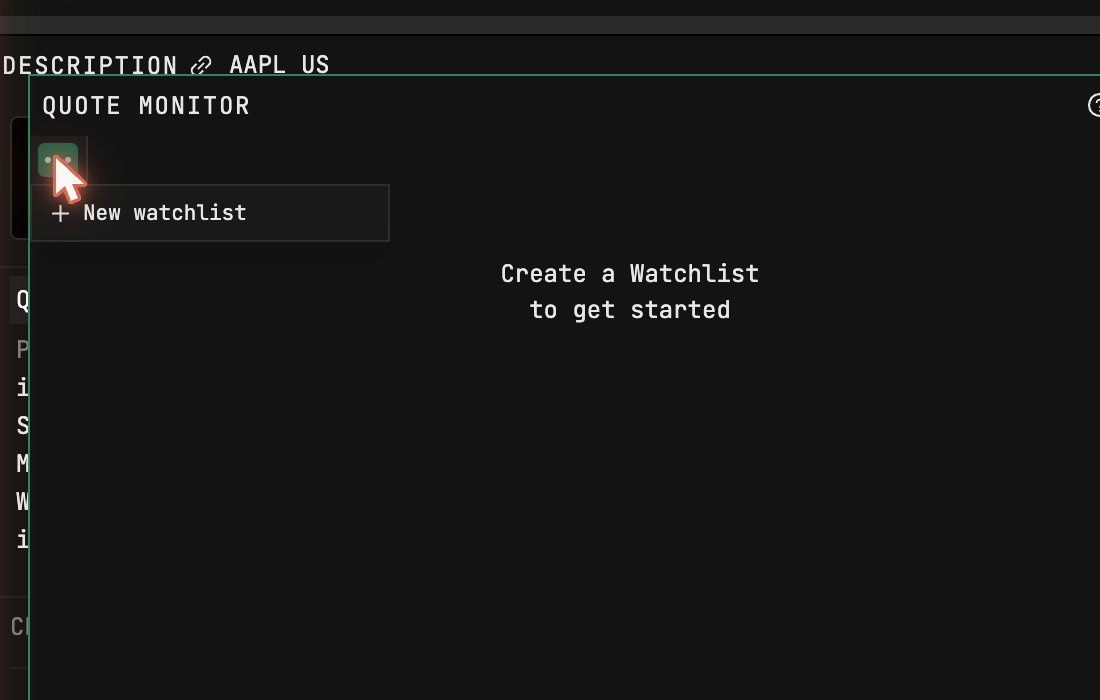
+ New watchlist. Name your first one. The design decision worth noticing: lists are universal — each exists once, account-wide, and any window on any layout can display it. Edit it anywhere, it updates everywhere. Sounds small until a morning workspace and a research workspace share one core list and neither ever goes stale.
Add a few tickers through the add box and watch the flashing start. That flash is a trade printing. Your app never told you.
The 400-ticker trick
Nobody should hand-type a real watchlist. Ctrl+I opens batch import: paste comma- or newline-separated symbols and it churns through them at roughly ten per second. Lists hold up to 400 names each, and a QM window holds multiple list tabs — one for core holdings, one for the sector you're stalking, one for this quarter's earnings names.
International names need their venue suffix — AZN LN for London, UBI FP for
Paris, P911 GY for Xetra, AC CN for Toronto (large liquid examples, chosen to
show the suffixes). They'll come in wearing a (D) badge: fifteen-minute delay by
design. I keep internationals on their own tab so the real-time flashing and the
delayed drifting don't sit in the same column pretending to be the same thing.
One warning I learned the annoying way: removing a ticker has no undo. The machine assumes you meant it. Remove with intent.
Columns are a worldview
Click the gear and meet Used Columns:
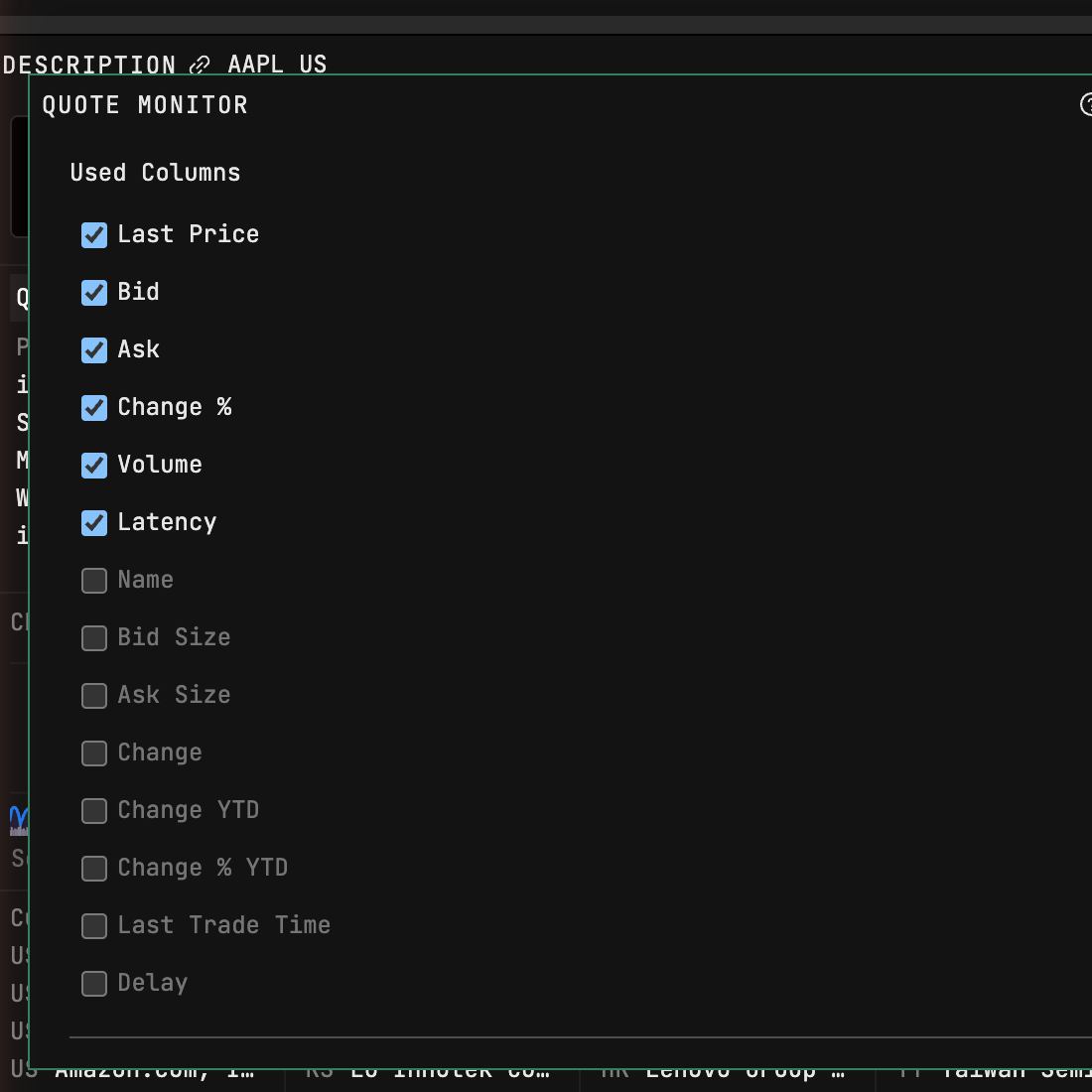
Defaults are Last Price, Bid, Ask, Change %, Volume, Latency. What you add says how you trade. My picks: Latency and Delay are the sleeper columns — they make data freshness visible, which is the entire point of upgrading off an app — and Change % YTD next to plain Change % gives every daily move its yearly context in one glance. Bid/Ask (and their sizes) are the paid plan's columns; on free they read "Account required," which is the tier fence, not a malfunction.
Click a column header to sort. Drag rows to hand-order them — noting that an active sort overrides your manual order until you clear it.
The click that runs the room
This is the part that makes it a cockpit instead of a list. Open a chart (G) and news
(N) alongside QM, arrange them — list left, chart and wire right — and color-link
all three with the chain icon:
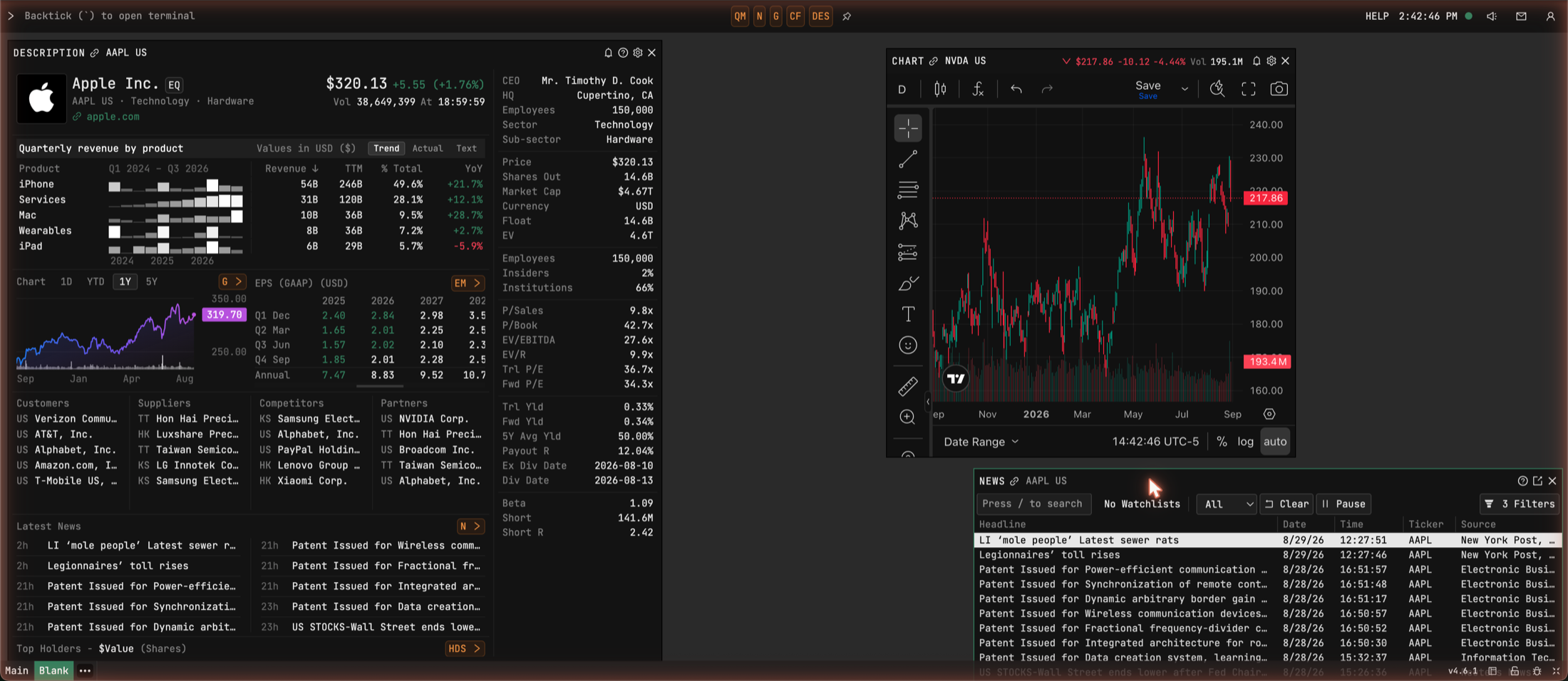
Now click a row. The linked chart re-points. The news re-scopes. One click, whole
screen, new ticker. Row-click behavior is configurable in settings — the settings
command is PDF, and yes, in this product PDF means settings; every operator does a
double-take once — and a right-click on any row opens the full command menu (DES,
G, N, OMON…) when you want something specific.
Two extensions worth wiring the same day: scope the news window to a whole watchlist
(the selector in N's toolbar reads "No Watchlists" until you pick one) so the wire
covers your book instead of one name; and feed a list into HMAP for a market-cap
heatmap when you want the day's shape in one image.
The part that watches while you sleep
The wall above only works while you're looking at it. For the other twenty-two
hours there's AL — desktop alerts on price or volume that fire as browser
notifications. This is the cure for finding out late: the level you care about
pings you, instead of you finding it in tomorrow's feed. One quirk: alerts are
one-shot — they don't re-arm after firing — so
re-set the ones that matter after each hit. My routine is thirty seconds at the
close: re-arm anything that fired, add a level for any name that earned a spot
on the wall today.
When it fights you
Import feels stuck? Four hundred names at ten a second is forty seconds — patience
before panic. A row looks frozen? Check the (D) badge; delayed is a feature wearing
a label. Bid/Ask blank? Tier fence. Clicks not driving the chart? All three windows
need the same color link — re-chain them. Left-click doing something weird? Your
row-click setting in PDF was changed; that's a preference, not a bug. And the
no-undo rule again, because it stings: re-adding the symbol is the whole recovery
plan.
Next: give these lists a better diet — the screener that finds the names worth watching.